
🏰
History
The history of Saxony comprises the history of the Free State of Saxony and the history of those territories on the middle Elbe that serve as medieval namesakes.
The cradle of today's Free State is the Mark Meissen, where King Henry I ordered the construction of a castle in 929 AD - this is where German settlement first began, later joined by Slavic tribes coming from the east.
These tribes, some of which were already principalities of large families, expanded more and more. From them arose the later noble houses that determined history in Saxony for a long time.
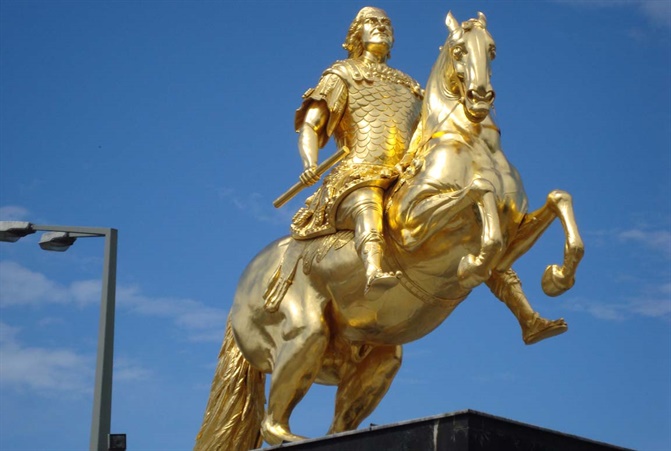
One of the most famous princes of Saxony was Friedrich August I of Saxony (born on 12 May 1670 in Dresden, died on 1 February 1733 in Warsaw, Poland), known as "August the Strong" - Dresden owes many Baroque buildings to him, such as the Dresden Reisdenzschloss, Moritzburg Palace and the Zwinger.
Like many other federal states in Germany today, Saxony emerged from a smaller kingdom of the same name, whose area and borders roughly correspond to those of the present-day federal state of Saxony. In 1870, this kingdom and other principalities merged to form what is now Germany.
At the beginning of the 20th century, Saxony was an economically very successful region in Germany and an important bridge to Russia. At the end of the Second World War, many Saxon cities were badly damaged, including Dresden. During the German Democratic Republic (GDR) from 1948 to 1990, Saxony again played an important role due to its proximity to the East and its economic strength. After reunification with the Federal Republic of Germany in 1990, Saxony became one of the five new federal states. Since then, 3 October has been celebrated throughout Germany as German Unity Day.
Since the time of the Weimar Republic, the predecessor of today's Federal Republic of Germany, Saxony has borne the title of a "Free State", i.e. a state no longer ruled as a monarchy but democratically, which was also officially incorporated into the name of the federal state after German reunification. Due to its size, population and economic/touristic relevance, Saxony is one of the more influential federal states within Germany.
©
#copyright_Polybert49_Lizenz_CC-BY-SA2,0